Tuesday, 2 April 2013

Fly Fishing: It’s not just what you catch, it’s also who you meet!


Today, I finally decide, forget the cold windy weather I have to get on the bank and so, after I had dropped my wife off to do some Family History Research, I headed down to Bewl Water.  I didn’t actually start fishing until around noon (usually the time the fish start their afternoon siesta).  As it was cold 6 C and very windy I decided to fish the north bank at Rosemary’s Lane and I asked a dog walker to take my photo just to prove I was brave enough to be there.


I fished by the oak trees but it seemed a bit quiet.  Another angler joined me and I went over to say hallo.  Hidden under a flashy warm “cover everything” hat and New York cop shades was the famous John Hancock Treasurer of the Bewl Bridge Fly Fishing Club.  We hid the hat so it would not damage the camera!
 
John, alias “Sooty” is the source of the much enjoyed joke page in the club magazine.  One of his more repeatable offerings is “Jonathan Ross has been accused of shoplifting a kitchen utensil from Tesco.  Ross said it was a whisk he was prepared to take.” 
John is a very accomplished angler and a “star” in his support of the club and the fishery in general.  He mentioned he had caught a fish further up the bank by one of the commemorative benches and so I wandered up there.  After about 20 minutes I hooked and landed a nice fish using an intermediate line with a white minkie on the business end.  Note in the picture my high tech priest!  I got fed up with leaving expensive fancy priests on the bank so I took a piece of plastic electrical conduit, forced a lead sea fishing weight up it, and wrapped some electrical tape around the end.  It works well, the fish don't seem to mind and I have never lost it!
 

Another angler called Mike joined us and proceeded to completely out fish me, this was partly due to the fact that I kept moving about into locations that were exposed to the strong icy wind.  Then I would give up and try somewhere else.  I was hoping to find a shoal so I could “bag up” and retire.
 
 
Mike had the good sense to persevere where he was, out of the wind and in the sun (as you can see he had a deck chair).  I even switched from my intermediate line to a floater like Mike’s and tried similar flies to him.  He was kind enough to let me photograph his excellent home tied flies and to video him landing some of his fish.  (The video takes a minute or so to load, so be patient!)
 
 
I did not have a very productive session but I did meet some lovely people and I enjoyed seeing the sun at last.
 
I definitely need more practice!


Monday, 1 April 2013

FLY FISHING WITH A BROKEN WRIST


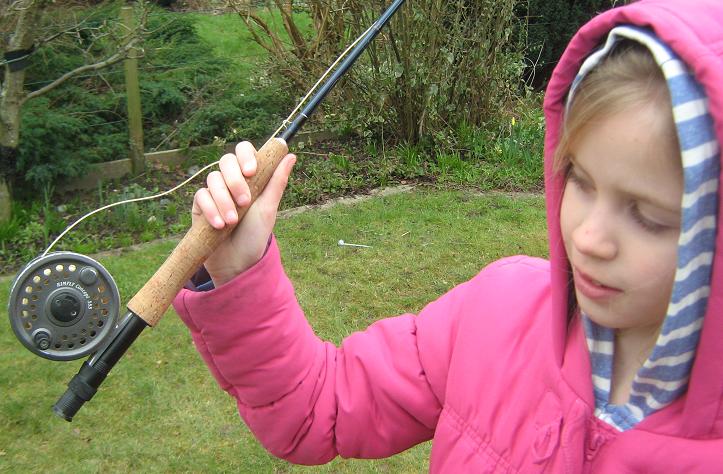
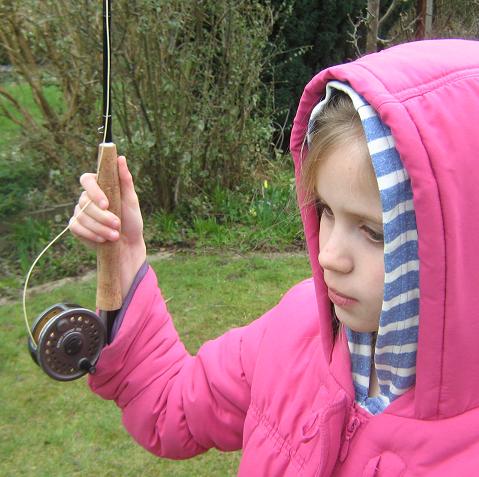
In my experience the most common fly casting fault amongst newcomers learning to cast is the broken wrist.  No, I don’t mean they fracture it and end up in the hospital casualty department (or the ER) screaming their head off!   What I am talking about relates to what happens to the wrist on the back cast. This is where the wrist is allowed to flex backwards taking the spring out of the rod and resulting in the line tumbling to the water in front of the caster on the forward cast.  You probably know what I mean as I think we have all done it.
Here is Emily (granddaughter age 10) learning to cast and slightly breaking her wrist!
 
Let us review some of the basics of fly casting:-
1.       The line is a long linear weight and we are casting the line, not the fly.
2.       Because the fly is attached to the line by the leader when we cast the line, some energy is transmitted down the leader and that in turn moves the fly.
3.       The rod is a spring and also an extension of the arm.
4.       When we use the arm to accelerate the rod through an arc, the weight of the fly line slightly bends the rod, loading the springiness of the rod.
5.       The loading of the rod spring, plus the movement of our arm, allows the fly line to be projected smoothly, if done properly, some distance.
6.       Casting a fly is more about the timing of the loading and unloading of the rod than it is about using strength.
Now if we consider a simple overhead cast the basic moves are:-
1.       Rod tip down just above the water.
2.       Smooth lift to 10 o’clock, note the surface tension of the water on the line starts to load (bend) the rod tip down.
3.       At 10 o’clock, without pausing, immediately accelerate and lift the rod until the thumb is vertical (by the side of the ear) and the rod at 1 o’clock. (The acceleration Joan Wulff calls a power snap, which is quite a helpful graphic description others refer to it as a “flick” as if you were trying to flick some mud off the rod tip).
4.       A pause whilst the line flies out up and behind and loads the rod tip i.e. bends it backwards (so it has energy to spring forwards).
5.       The instant the rod is loaded the rod hand is pushed forward and this movement plus the spring in the loaded rod projects the line forward.
6.       Ideally, the rod is then stopped at 10 o’clock whilst the line projects forward and when it is fully extended the rod and line are lowered so the whole line rests gently, we hope, on the water.
Now if, during 4 above the rod tip is allowed by a floppy or “broken” wrist to carry on travelling back, the rod remains straight, does not get loaded and the forward cast degenerates into a "chuck" rather than a cast.


Now with some novices this broken wrist action can be so bad that the rod not only passes through the horizontal, the rod tip can actually touch the ground behind them!!  (Poor rod tip, the ground always survives.)
So how do we correct a broken wrist?  Well, I use a stepped approach along the following lines:-
1.       I explain why it is bad to break the wrist.  And if that does not work …..
2.       I show them the 3 finger spacing rule.  And if that does not work …..


3.       I stand behind them with my arm held up high and tell them they owe me money if they hit my arm with the rod on the back cast. And if that does not work …..
4.       I threaten them with a physical restraint.  Some smile when I say that!  My physical restraints come in a variety of forms.  If they have a long-sleeved item of clothing on I get them to put the end of the rod handle down the sleeve. 


If that is not an option then I use one of the following:-   lady’s elastic tight tops; Velcro strap, rubber inner tube. 

The lady’s tights tops always get a lot of interest from elderly gents!   They are good because they are elastic and you can adjust the tension by employing more loops round the wrist or round the rod butt.  Now the physical restraint should allow a little movement of the rod backwards, and the caster will feel it is a bit awkward, but they usually do not fail to agree that as a result their casting has suddenly improved.
One time I was teaching a colleague, let’s call him “Bob” (as that was his name).  In spite of doing all the steps above Bob still kept executing back casts that resulted in the rod ending up in a horizontal plane.  He would vehmently deny that he was doing it!  One time he even hooked a sheep on the back cast!  Needless to say he didn’t land it!  The fascinating thing for me was that he was in complete denial that he was breaking his wrist to a colossal extent.  In the end I resorted to "plan X" the video camera and the statement “the camera doesn’t lie”.  Bob can cast quite well now and we are still friends.
Now before the casting experts “beat me up” let me add that when a caster has got a feel for the timing and the rod action, yes, we do use a bit of wrist action!


Wednesday, 27 March 2013

FLY ROD CASTING: REASONS TO USE YOUR OTHER ARM


First off a big thank you to everyone visiting the blog.  I am amazed at the following round the world.  The blog has been visited by fishers from 23 different countries!  I have been delighted with the positive comments from fishers and non-fishers alike.  Please do not hesitate to add to what I have posted or to put me right if you feel I have got something wrong.  You can do it by posting a comment at the bottom of the posts. The weather here in the UK is still very cold and wintery so I am blogging rather than fishing, but that will change soon and I will be able to make my posts more exciting!

Most of us have a favoured arm when it comes to casting.  In reality a lot of single handed rod fishers only have one “casting” arm.   However, there are many reasons why it is a good idea to be able to cast with both arms.  Let me review them:-

·         You have flown abroad on a fishing trip and on taking your suitcase out of the taxi you sprain the wrist of your casting arm.  Disaster!  However, if you can switch arms for casting you could prevent the holiday being a total failure.

·         A strong wind is blowing the fly behind you on the back cast and you run the risk of imbedding the fly or heavy lure in the back of your head on the forward cast.  Being able to change casting arms means that the wind is now blowing the fly away from you on the back cast.  You are safer and don’t have to keep ducking or resorting to casting across your body or forward casting away from the water and laying the line on the water using the back cast!

·         Being able to cast left-handed means that in an adverse strong wind you can move away from all the right-handed fishers and fish a location that is less disturbed, catch more fish and leave them green with envy!

·         When sharing a boat with a companion, ghillie or guide you can cast with an arm that takes the fly over the water and not over the boat occupants.  I find fewer apologies are required!

Fishers on the Yakima: Left and right-handed casting keeps the guide safe!

·         When teaching your left-handed pal, you can hold the rod the same way they are.

·         Particularly when river fishing, being able to cast with both arms means you can handle dealing with obstacles and the wind better.  Also, you can cover both sides of the river more comfortably. 

·         When the fishing is a little too easy (yes, that has been known to happen) and (say) you are on a four fish ticket/limit, having caught the first brace fairly quickly you can make it a little harder by switching rod arms.

·         When your favoured casting arm feels like it is about to fall off (often a sign of poor casting technique) you have a fresh arm in reserve.

Now learning to cast with the other arm is almost as difficult as learning to cast with your usual arm but all it needs is practice.  The best way, I am told, is to get two identical rod and line setups and practice the overhead cast action with both rods simultaneously.  You don’t even have to be casting on water, casting on short grass can be fine.  Now when my wife reads this she will know why I keep our lawn nice and short!  When fishing, a good time to practice is when the fish are having their afternoon siesta.  At that time, you probably don’t want to pack up and go home because you are anticipating the evening rise, so to usefully use the time, have a casting practice session.    I also favour having my own “siesta” as when I get tired even my good casting can end up as aerial knitting!

So rise to the challenge, be brave and let’s see you becoming ambidextrous and more able to conquer the conditions and land more fish!  Wow! I surprised myself with that line.  Am starting to sound like Joan Wolff?


Saturday, 23 March 2013

Trout Fishing Bonanza, Bewl Water Opening Day


Let me start by saying I got it wrong at first.  Having got my ticket I tossed up as to whether I should fish Bramble Point or drive to Wards Lane and fish Bryants inlet, and the latter won. When I got there I found it busy with chaps who looked as though they had camped there.  So I took the challenging walk to Beauman's, stopping to fish"Green bank", because the water was so high the foot path was under water and I had to blaze my way through jungle!  When I got there I had it all to myself until I had a visit by boat from Rob Dixon the fish farm manager in his role as Water Bailiff.  He was diligently doing his rounds checking permits.
I always like to see members of the the Fishery team because they are a useful source of knowledge.  He said people at Bramble point had already bagged up (meaning they had caught 8 fish and it was only 0900).  He suggested that I was in a good spot to catch a bigger over-wintered fish so I pressed on.  Eventually I was rewarded with a beautiful "blue" trout.
 
As I wasn't hitting lots of fish I did what you should always do, i.e. change something, so I moved on walking round Beaumans to "The Nose".  Enroute I thought I was in South America when I saw a Llama!

I had a few casts on the way but the wind was very cold and in my face and there were no signs of fish. Surprise, surprise when I got to "The Nose" I found the chaps I had seen previously at Bryants. They had caught a few fish there and caught a few more at The Nose.  However, they said it had gone a bit quiet and as they moved on so did I.

I decided to cut my losses and drive back to the Fishing Lodge for advice.  If I had used my brain I would have called them from my mobile.  The fishery staff want you to be successful (then you'll come back) so they are always very helpful.  Anyway, I saw Vince Brook (who fished for England) and Rob Dixon and they said Rosemarys Lane was fishing well. So, have rod, will travel. I parked by the small dam and as I was walking in I met a fisher walking out with his 8 fish.  He said it was fishing well, so all excited I found a spot on the bank between a couple of fishers, having asked if that was OK with them, I started to get serious.  As you can see from the picture below it was busier than usual but nothing like what our American friends call "combat fishing". This is when you are standing shoulder to shoulder.

 
 I caught some nice fish, using an intermediate line with a slow retrieve.
 Black and green lures and white minkies all worked. The fish responded savagely when hooked.
I made friends with Andrew who was fishing next to me and was catching consistently. So much so that I took some pictures of him.

 
 I started to bag up, ending the day with 4 fish, the blue was in the car.
 Andrew was really in the groove.
 So with his permission I videod him. Short but sweet and hear the wind!
 
Tired and a bit cold I packed it in around 1600 as my wife wanted me to go dancing that night.  That was good, too, but man did I sleep well.


Monday, 18 March 2013

Accidents with Fish Hooks


With the start to the trout fishing season just about to kick off big time, I thought it appropriate to mention some helpful “dos and don’ts” relating to fly fishing and hooks.  The most important DO is to always wear eye protection.   Instructors will not teach pupils unless they have glasses, sunglasses or safety glasses on. 
On means covering the eyes, not perched on the top of your head!

As far as I can recall I personally have only ended up on the point of a hook on two occasions!  Both were memorable and graphically illustrate some don’t. 

I am going to mention the least traumatic one first.  If you can cope with that without passing out then you might want to read on.  My pal George Kolar and I were fly fishing, wading the salt (fishing in the sea) at the entrance to Pagham Harbour (a nature reserve on the south coast of the UK).  We were after sea bass.  It was fairly windy and the tide was coming in fast.  I had caught a couple and thinking I had seen the flash of a big fish, I tried to change cast direction in mid-air.  The wind caught the fly and buried it in my ear lobe.  I cut the leader, tied another fly on and fished on.  When I saw George walking out of the water I followed him and giving him my Leatherman asked him to please remove the fly from my ear.  He took one look at my ear complete with dried blood running down my neck and said, “Alan, I don’t do blood.”  So we carried on fishing and I pulled it out later using  the car wing mirror as an aide.  If you can cope with that read on.

The other time I hooked myself was years ago when I was learning to Spey cast on the River Tay with Michael Evans the renowned salmon-casting instructor. So we are talking 15 foot two handed salmon rods and large, heavy flies.   Whether you are single or double Spey casting depends on which bank you are on. I had been casting using the appropriate cast on one bank during the morning with no problems.   After lunch we swopped banks and I got confused as to which cast I should be using.   Now on the forward cast I am told the fly can be travelling at over 200 miles per hour.  So when I did a powerful wrong cast and the fly hit me in the face I thought I had been shot!!!   Immediately, the current grabbed the line and started pulling it downstream.   Fortunately, I had the presence of mind to catch the leader and bite through it so I didn’t get dragged downstream by my face!   Staggering out of the pool I was intercepted by John, the ghillie.  He suggested that I sat on a log whilst he assessed the situation? 
 
The fly was aptly named a “Munroe Killer” and it was a double, that is, it was two barbed hooks joined together.  John said it was buried in my face up to where the hooks joined.  When I said it sounded like a hospital job, he replied “You don’t want to be wasting your day hanging round a hospital.”  So I asked what the alternative was and John said he could get it out using a special trick that would not leave a scar.  I asked how he did it and he said it involved using a bit of line.  I didn’t understand but I resolved to trust him.  All he did was to tie some strong line to the shank where the two hooks joined together, put his hand on the side of my head and jerk the line really hard.  I said (rather loudly) Wow! Is it out?  He replied no, but it’s half out!  Then followed another tug and I was no longer “hooked”.  Surprisingly this had not hurt me much because the fly had hit me so hard the area around it was numb.  John was right, I was left with no scars, the hooks came out the way they had gone in, and the torn holes healed perfectly.  In spite of being somewhat shaken by the whole experience I tied another fly on and staggered back into the water casting very carefully. When Michael Evans turned up to see how we were getting on I expected to be chastised, however, all I got was a “Hear you have been in the wars Carter”!  Michael then got John to tell me how he (John) had cast a treble hook up his own nostril!!!   I said that must have been a hospital job?  John said no the water was freezing cold so he buried his face in it till his nose was numb and jerked it out.  Michael said that there was rather a lot of blood involved! 


All’s well that ends well, so on that trip I did end up catching a rather nice fresh run 7 lb Atlantic Salmon.

Friday, 15 March 2013

FISHERMAN IN TROUBLE WITH WIFE!


Oh dear, I am in trouble!  My wife, Rosalind, thinks I am spending too much time blogging about fishing etc!  I told her it is my new hobby and she responded by saying OK but would I help her with her hobby? 
How could I refuse such a lovely lady after 46 years of married bliss?  So let me tell you about my wife’s rather unusual hobby called “Home Staging”!  I first heard of it when my son Dan and his American wife Holly wanted to sell their house at Leigh-on-Sea, quickly and for a good price, so they could move to the USA.  We went round to help get the house ready for sale only to be introduced to Denise the “Home Stager”.  We were told that Denise was providing advice on what needed doing to give the house “buyer appeal”!  At first I was a bit sceptical (as usual) but Denise had lots of energy and brilliant ideas and worked hard advising and improving their home.  The net result was that they sold it immediately for what they felt was the right price.  Now unbeknown to me Rosalind was watching Denise and the whole home staging thing very carefully.  A few weeks later following some research Rosalind announced that she wanted to be trained as a Home Stager by Ann Maurice of House Doctor fame.  I surrendered (as you do) and Rosalind did the necessary training and assessment projects in order to qualify as a consultant.  Since then Rosalind has had great pleasure in helping people “stage” or “makeover” their homes on both sides of the Atlantic.  She seems to specialise in helping people, who desperately need to sell their house, to improve it so they get a quick sale.  She has also given advice on how to “makeover” rooms to improve them.  It gives her great satisfaction to improve a property at very little expense and then to see it sold for a higher price than originally estimated.  From my point of view (obviously biased) it has confirmed my opinion that my wife has more design ability in her little finger than I have in my whole body!  If you fancy having a look at her website here is the link:-
The only downside for me is that sometimes the people Rosalind is helping want her to undertake the transformations and I find myself putting up pictures, curtains and shelves!
Here are a couple of examples of her work that are among my favourites.
Tatty old loft space becomes a desirable guest room
Tired old kitchen is extended and modernised.

Wednesday, 13 March 2013

Fisherman’s Shoulder Operation: Rotator Cuff Repair

The year before last I hurt my shoulder fishing!  No, it was not fly fishing.  I did it on the beach chucking 4 ounce weights using a long beach caster rod and a fixed spool reel.  (My friends in the USA call it gear fishing.)  The target was a shoal of mackerel swimming up the English Channel.    I was putting a lot of muscle into the casts as I was fishing with my pal Graham Henson who is a few years older than me and who was consistently casting about 20% further than I could.  (I found out later that he was using a fine braided line whereas I was using mono.) 
My son Jason with the offending beach caster rod!
Anyway the reward for my effort was not a bucket full of mackerel but what I thought was a pulled shoulder muscle at the top of my left arm.  So I rested my arm, put up with the pain and waited for it to get better.  Well the pain eased a bit and months went by and I started to notice that I did not have the mobility with my arm that I had previously enjoyed.  In particular I could not reach across the car to open the glove compartment.  Also I could not reach behind me with my left arm to get anything from the back seat of the car.  My doctor gave me a course of anti-inflammatory tablets and they did nothing to help so back I went and I ended up seeing a surgeon who specialises in shoulders.  His name Mr Iossifidis I never quite managed to master, so I resorted like everyone else to calling him Mr I.  Aided by some X-rays and a brief examination Mr I announced that I had damaged my “rotator cuff”.  I didn’t know I even had one, so it came as a bit of a surprise. 
Everyone has two rotator cuffs
 
I went on the web and found a good video clip all about shoulders (there are hundreds of them).  See 
 
 
Anyway I agreed with Mr I that he should operate.  Then he told me that I would not feel any pain for 24 hours after the operation because I would be injected with a “pain blocker”.  So I said “And then what?” and he said “Then it will be very painful and you will not be able to drive for 12 weeks.”  Well I consider myself quite tough when it comes to pain, I even have teeth drilled without an injection, but when that pain blocker wore off Wow! it made my eyes water.  Not only that, but I could hardly move my arm for ages so I suffered the humiliation of having to have my wife help put my socks on etc.  Then for several weeks I had to do really gentle exercises just to get some mobility, and then I had to start more strenuous exercise.   I had to exercise 4 or 5 times a day and each session started the pain off again.  Then I started physio with a young lady called Amy who was tough enough to have been a “storm trooper”.  Slowly my arm got stronger and the pain faded away and I could touch the ceiling again and open the glove compartment in the car.  I knew I was well on the way to being “mended” when I got back on the river bank.  So my advice would be:-
1.       Look after your shoulders.
2.       If you do damage your rotator cuff by all means go on the web to understand what you have done.
3.       Don’t watch a video of how surgeons do key-hole surgery, as that would really put you off.  Key-hole surgeons use a lot of heavy handed tactics to put it mildly!  I watched a clip a year after I had the operation and boy did I understand why it was so painful for so long.
Fortunately when I had the operation I was still working and covered by the company’s hospital plan so I didn’t have to wait for the operation or pay for the treatment.  Just out of interest I kept track of the total cost of all the treatment and it was in the order of £6000 say $9000.
Well looking back on it, I should have left the 4 ounce weight chucking rod alone and stuck to my fly rod.  A mackerel on a fly rod can be a lot of fun.