Showing posts with label fly fishing. Show all posts

Monday, 1 June 2015

Golf versus Fly Fishing! Which is Best?


I have to admit that I am biased! It all started when I was employed as a seventeen-year-old student apprentice draughtsman and my boss was an elderly gent called Ian Flower who was captain of the Ministry of Public Building and Works golf team. I asked him if I should take up golf? His response was "Alan it's a good walk spoilt!" So based on that piece of professional advice I crossed golf off of my things to do list!
So how did I get interested in fly fishing? I got hooked on fishing when my elderly grandfather took me to fish on the River Thames at the age of around ten. I was a bit frightened of him but he set me up with a rod and reel instructing me to watch the float and if it went under to lift the rod to hook the fish. I watched the float like a hawk and when the float popped under I whipped the rod up vertically! The float and a little fish went sky high and the fish landed in my lap having come off the hook whilst airborne!   Grandfather was not impressed but I was as the exercise revealed that there were things swimming around in the depths of the river and you could catch them!  
So from then on I could never look at a river, lake, pond or puddle without wondering what denizens might be lurking there, and the only way to find out was to try and catch them. So my life-long love affair with water and fish began quite humbly, netting baby trout in among reeds with cousins, catching a jack pike and bringing it home in a Wellington boot filled with water, fishing the Thames at Hampton Court etc, etc. As I grew older I got interested in sea fishing but not living near the sea meant that I never got any good at it. All that changed when in my mid twenties I was posted to work in Gibraltar!  Gib is three miles long three quarters of a mile wide and is practically surrounded by sea, heaven on earth for me! But that is another story. 
Three years later when I came back from Gib I started sea fishing again in the UK and found it a waste of time because of inshore netting by trawlers, difficulties of getting bait and my distance from the sea.  Discussing this with Harry Shannon at college (I was doing a part time degree in HVAC engineering) we decided to have a go at trout fishing in a water that was stocked. We started at Weir Wood Reservoir and tried to teach ourselves to cast. I will always remember when Harry hooked his first fish as he had no idea what to do. He was fishing at the bottom of the boat ramp and landed the fish by backing up the ramp until he had pulled it out of the water!

Well that was how I started fly fishing, my big mistake was thinking I could teach myself to cast properly by just reading books. I could cast and catch but later when I wanted to qualify as a Salmon and Trout Association National Instructor I had to have lessons to unlearn all my bad casting habits. That was a humbling experience but mentors like Michael Evans helped. 

So back to the golf versus fly fishing question!  Let's deal with the similarities first. Both activities get you out in the fresh air. Either location can be beautiful but I would beg to suggest that fishing tends to find you in a naturally beautiful place whereas golf finds you in a man manicured environment!  Both sports require some skill and that comes from knowledge and practice. Both sports require equipment and the advertisers suggest the more you spend the more skilful you will be. This of course is nonsense!
Now golf is a competitive sport, you play against someone, so, too, is fly fishing if you go with friends. You may not feel it is competitive, until they are catching and you are not, then it becomes competitive!

Another similarity relates to the jargon in each sport. Banging balls into small holes in the ground is so unimaginative an activity that terms like "a birdie" or "an eagle" have been invented to make it sound interesting. With fly fishing we have terms like "tippet" and abbreviations like "ptn" (pheasant tailed nymph) and the whole nonsense of the number of different fly patterns.

So what are the differences between the sports. The main one I would suggest is that in golf the holes don't move (even if they see the golfer)! Whereas in fly fishing the target (the fish) do move (especially if they see the angler).  Another important difference is what happens when the golfer or fly fisher hits the target. In golf the ball lies quietly in the hole and the golfer pats himself on the back and the crowds cheer. In fly fishing the fish takes the fly, feels it's point and immediately all hell breaks out and the real excitement begins as the fish tests the fishers skill.  I have seen so many fish lost (by me and others) whilst being "played" usually because fishers are too impatient. 

After the golfing or fishing session both parties have a story to tell but I would imagine the golfer has to be more skilled at the telling in order to make it interesting than the fisher after all usually the fish has quite a lot to say.

Golf matches on TV are only watchable because there are so many cameras simultaneously filming a number of players that there is always some sort of action televised.  If a similar number of cameras were used to televise a fly fishing event I think it could be equally exciting if not more so!

I hope this stirs some of you into a response!

Thursday, 18 September 2014

Chalk Stream Fly Fishing Masterclass

Yours truely on the chalk

Because I do so many different kinds of fly fishing I tend to be a "Jack of all and master of none".  Now I am retired I am keen to improve my chalk stream performance because being a member of the Salisbury and District Angling Club (SADAC) I have, for a reasonable annual subscription, access to a lot of lovely water and beautiful fish.  Acknowledging that local knowledge is king and having not fished the club waters for several months I decided to pay a visit to the office and seek the guidance of the Fishery Manager, Andreas.  After we had swapped a few stories and discussed ways of avoiding backache while fishing he advised me where to fish adding that he would be there later himself.  
 
Andreas focused

So later that afternoon I got to fish with Andreas and it turned out to be a master class on how to outwit the fish and catch.  Here is a summary of the key things I learnt:-
  • I am reasonably good at spotting fish but Andreas was better.  I think the fact that his Polaroid sun glasses had side shades gave him an advantage.  I have never bothered to fit mine side shades but I will now.  
  • He knew the river far better than me and where the fish's favourite feeding locations were.
  • He prioritised the nearest fish, crouched forward and really focused on them and what they were doing.
  • If fish were not seen to be actively feeding he left them after a few casts and moved on.
  • He used a longer leader than I, say around 12 feet.
  • He used smaller flies than I, sixteens and eighteens.
  • He was constantly watching the fly life around, both above and on the water.
  • If there was no top of the water activity he switched to nymphing.
  • When the sedge were hatching he used F- flies, little V shaped CDC flies in brown or black.
  • As the evening drew to a close and activity on the deeper water slowed down he moved us to the faster riffles where there was lots of surface activity.
It was a privilege to have fished with an expert who so willingly shared his knowledge.

The reward a pretty brown

Salmon parr

Searching for bigger fish under the trees

Supper!

A stripped and twisted willow twig makes a handy fish carrying handle!


Saturday, 19 July 2014

GOOD NEWS: FLY FISHING HAS NO AGE LIMIT!

One of my American friends shared this picture with me.  It reminded me that I am 68 and very blessed to still be pretty mobile. 

This week I am off to the States on holiday and "have rod will travel" I will try to keep you posted on my adventures.

Friday, 23 May 2014

Back on the chalk streams with the Salisbury and District Angling Club

My brother Chris finally on the water

Finally my brother and I got on the water on the 19th May. The weather was kind and I showed him the club beats at West Amesbury. There was plenty of water and it was a bit coloured so I took him down the club office (interestingly called "The Cart Shed") and as it was windy we picked beats 18 and 19 as the trees provide some shelter there.  The water seemed clearer and it was just great being back on the chalk.  He managed one BT and I managed three all on klinkhammers. The fish were small but beautifully coloured. We then tried beats 8 and 10 and met up with the bailiff who was fishing 9.  We all blanked (including the bailiff, so no shame).  There was the occasional mayfly showing.
 
The next day I fished the Wylye for a couple of hours on my own and had 3 BTs and 2 grayling.  The water was clearer here but the wind made casting a bit tricky.

I cannot wait to get back and enjoy some more of these lovely fish.

Wednesday, 21 May 2014

BEWL WATER: HOW TO FIND THE TROUT ON WINDY DAYS

There are literally thousands of trout in Bewl Water.  However, because of its size sometimes it can be a bit of a challenge to find the fish.  Normally, one would ask Janet or Coral at the Lodge or speak to one of the fishery team on the jetty.  They want to help you because they want you to catch (happy fishers come back!).  You can also help yourself by watching other boats (binoculars can be useful) and trying the locations that regularly hold fish, like Rosemary's Lane, Canoe Club Corner, The Nose, the top of Hook Straight, Monty's Seat, etc.  Now the fish tend to go where there is food so a northerly wind blowing over the top of the main dam pushes the surface water away from the dam and that draws up water and potentially food from the depths.
 
If the wind has been blowing in the same direction for several days really experienced Bewl fishers can usually predict where the fish will be.  Usually they fish on the drift (loch style) with a drogue (underwater parachute) out to slow the drift down and keep the boat at right angles to the wind.  This means you are always covering fresh water.  If I can I like to start my drift from a known point like a buoy.  This is so that if I find I am travelling over fish and hopefully catching them when the drift is exhausted or I stop catching I can motor back and repeat a similar drift.  If you see another boat on the drift catching then you can motor in behind them (allowing plenty of space) and follow their drift. What you must not do is sneak in front of them as that is regarded as poor form and will probably get a verbal response!


After my last session at Bewl where I actually saw the fish being stocked, Vince Brooks who works at the fishery and fishes for England, kindly stopped and gave me the following advice on how to speed up the process of finding the fish especially when it is windy:-
  • Use a sinking line
  • Tie on a large lure
  • Don't use the drogue
  • Cast and retrieve like crazy!
Doing this you drift fast and cover a lot of water but it speeds up the process of finding the fish. Having found them you may want to try a more subtle approach.  I am looking forward to trying Vince's approach on my next visit!
 
However, now I am being tempted by the chalk streams and the mayfly.  My next post will be about that.


Monday, 24 March 2014

Report on this years first outing to Bewl Water

 
Well I could not wait, so I just had to go to fish Bewl a couple of days after the opening of the new season.  I had three pals, two of whom I had been teaching casting on grass, who I had promised some serious fly fishing.  So Malcolm, Niel and Reece (the latter two from the USA) joined me on a cool but bright morning.  Having given Malcolm and Reece a brief demo of what to do, with their boat moored to the jetty, I let them loose.  When Niel arrived he was glowing having just passed his driving test and we set off after the others. Having been briefed at the lodge and jetty we knew where to go.  Fishing on the drift was a bit tricky because we wanted to be close to the banks and were hindered by the wind shifting all over the compass!
 
 
Still cats whiskers, gold headed daddies (with rubber legs) and even a minkie booby did the trick.  The boys learnt all the things not to do, like fishing slack lines and lots of fish were touched and lost but eight did come to the boats and boy did those fish go.  The fish were nearly all 2lb plus and some were nearer 3lb.
 
 
Let the pictures speak.


I don't know about the others, but I just cannot wait to get back!  As we are all doing voluntary work at the London Temple, near East Grinstead, we will have to wait till next Monday, as Mondays are our one day off.  Roll on Monday.


Tuesday, 11 March 2014

Beginners learning to fly fish at Coltsfold Mill Fishery, Oxted, Surrey, UK

 
Well the weather has improved (that is it has stopped raining) and I have been able to get to the waters edge at last.  The occasion was an outing for Niel, Bryant and Malcolm, the three chaps I have been teaching to cast on grass.  Today was the big test, had they been listening, had they understood, had they remembered and if the answer to all those questions was YES, then could their brains make their muscles do the right thing!  Well the answer was both YES and NO!  Sometimes they got it right and the line went out reasonable well and sometimes the timing was wrong, too much effort was used, the wrist was broken and the result was dumping and knitting.  However, we had fun, enjoyed the venue and three large rainbow trout were caught.
 
The venue was Coltsfold Mill, near Oxted, Surrey, UK, a well managed trout fishery.  The bailiffs Neil and Paul were most friendly and helpful. 
 
The pictures can speak for themselves.
 
 Mill lake
 Niel with the biggest fish
 Malcolm with one of his two
 Bryant fishing the lower cascade
 Neil the helpful Fishery Manager
 
The gold headed daddy longlegs (complete with rubber legs) that proved very effective.


Monday, 27 January 2014

Fly Fishing Action at Boringwheel Trout Fishery

A few days ago me and my pal Chris managed to slip away from our voluntary duties at the LDS Temple at Lingfield and visit Boringwheel Trout Fishery.  I had not been there for some 20 years.  It was a dull dreary wet morning (not like the picture below) but during our 3 hours there we both caught a brace of beautiful fish.
 
I pinched the picture and the following blurb from their web site.
Situated in the heart of the Ashdown Forest, just off the A22 at Nutley, this 400-year-old spring-fed lake offers 6 1/2 acres of peace and tranquility for the discerning trout fisherman.
Boringwheel offers first-class hard-fighting fish on a water that once used to power a mill producing the guns for England's medieval fleet of warships. The lake takes its name from the historic mill, and to the discerning fisherman it's anything but boring!
You can fish from the bank, from the well-maintained wooden fishing stages, or you can use our boats free of charge. Our resources include two holiday cottages, a mini golf course, corporate entertainment facilities, refreshment provisions, and toilet/washroom.
All fish must be taken as Boringwheel does not allow catch and release.
Following the heavy rains the water was a little coloured so we used cats whiskers. The trout were in top fighting form.  We will be back and might see you there!!!

Sunday, 12 January 2014

Things to do when the weather is too bad for fly fishing

 
Let me first say the weather has to be really bad to stop me fishing.  However sometimes the rivers are "up and out" as my friends in the States say (see the Daily Mail picture above).  This means that the river levels are high and the fishing impossible due to flow rates and water clarity.  It is common place in the States to be able to go on a web site and get the actual flow rate in cubic feet per second. This is starting to be more common in the UK and I go on the web to check what the Wiltshire Avon is up to before I drive 100 miles to fish it. See http://www.environment-agency.gov.uk/homeandleisure/floods/riverlevels/
Also lakes and even rivers can be frozen over.  I have managed to successfully fly fish for trout on partially frozen lakes and have fished for grayling on rivers with mini icebergs drifting past.  If the air temperature is around freezing the fly line will stick to the rod or rod rings (called guides in the Americas). This tends to inhibit casting but immersing the rod in the water for a couple of seconds usually unfreezes everything long enough to get a cast in.
 
So for the days when fishing is impractical here is a list of alternative fishing activities:-
  • Sort through the contents of your tackle bag(s) and get it ready for the next trip.
  • Examine your rods for damage and clean and repair
  • Clean and check reels, lightly oil if necessary
  • Clean and check fly lines, paying special attention to where and how the leader is joined to the main line.  Replace damaged lines, or if double tapered lines consider reversing them.
  • Clean and check all your outdoor fishing clothing, waders, fingerless mitts etc.
  • Tidy up your fly boxes and label them
  • Tie a few extra flies or if you don't tie have a look at some fly tying videos on YouTube and get tempted.  Flies like buzzers and pheasant tail nymphs are fairly easy to tie.
  • Read a fishing magazine, write them a "star letter" and win a fishing rod (like I did a few years ago).
  • Join a fishing club and get on their forum.
  • Carry out an "inventory check" to see if you need any more tackle.
  • Phone a friend and plan a future trip or holiday.
  • Start or update a fishing diary or log or you could even start to blog!
  • Develop a boasting book of fishing pictures (paper or electronic).
  • Read or re-read the fishing books on your shelf, or join a library.
  • Practice tying the knots you want to use but have yet to master. See www.animatedknots.com
  • Watch advanced casting techniques on YouTube  such as the Snap Tee or Circle C.
So there is plenty to do.  Taking advantage of a "window in the weather" I gave Bryant an american pal a quick lesson at Albury and this was the result!


Then I got really lucky the other day in East Grinstead.  I popped in to the tackle shop to see if there were any trout fisheries in the area that I had not heard of and I met up with a gent who had brought in all his old tackle to dispose of and we ended up doing a deal.  He went off with some of my money and I filled the boot of my car with his tackle (all in front of my very understanding wife)!   I count my blessings.       

Friday, 8 November 2013

Bewl Water:Temperature dips so change of tactics required!

My friend Rowland and I were fishing Bewl and I thought that the floating booby and hopper techniques of a few days earlier would still work.  However, after an hour on the water drifting over the recent "hot spot" there was no sign of action.  So we motored round to the upwind side of the cages and tied up to a buoy.  We soon noticed that another fly fisher was hitting fish.  Not being proud and wanting to make sure Rowland connected I called across and asked what they were on.  He kindly replied that it was gold head daddies a few feet down. 

I switched immediately and on my third cast was rewarded with a fish.  Then I went on to have some more takes and I got broken and lost my last Daddy.  Rowland kindly gave me one.  I think he gave it, but he might only have lent it!  Anyway I have still got it! 
 

This is the gent who kindly tipped me off as to what to use and how to fish it.  By this time another boat had moved on to a buoy the other side of us and they were immediately into fish. Then a chap with his girl friend turned up.  She must have been very devoted to him because it was quite cool and a bit breezy and bumpy!

 
I came away with four good fish and Rowland had his share.  Back at the car I spoke to the guys from the other boat, one had eight fish using a cats whisker and the other had four.  Thinking back I realised that the fish I had caught had all taken the daddy when I was retrieving quite fast.  I think if you retrieve a daddy fast it tends to look more like a lure imitating fry, so maybe I could have caught simply using lures.

 
A cats whisker fly

Friday, 4 October 2013

Some tips on boat fly fishing for trout at Bewl Water, Kent, UK, and success with a magic Booby!


Let me start off by saying the best thing you can do is to join the Bewl Bridge Fly Fishers Club (see link at side of page) where you will get loads of help especially via their bi-monthly magazine the “Bewl Angle”.  As you will see if you stagger to the end of this post it was through reading the magazine that my trip yesterday went from failure to success.

On the practical front here are some suggestions you may already be aware of or you might like to try.  Firstly the whole object of having a boat is to have the ability to be mobile (like the fish) and to be able to cover the whole water (except the bird sanctuary where the really big fish hang out)?  If you’re not seeing fish, and catching, then move.

So you have hired a boat and been given a boat number, before you set off, check it out.  The staff are very good but they often get to clean and check the boats just as it is getting dark. 


Look for an anchor (it is attached to a red buoy so that if you get it caught on the bottom you can untie the anchor rope and leave the buoy marking the spot where the anchor and rope are.  The rangers can then try to recover it.  Oars are a useful plan B, although most of us have the fishing lodge number in our phone which is a better plan B.  Many years ago as dusk was falling at Rosemary’s Lane I foolishly let a beginner operate the engine to take us back to the lodge.  John tried the other way of stopping and sheered the pin that holds the prop on, then he announced that he couldn’t row.  Exhausted, I slept well that night!

 Note the small G clamp I have attached to the edge of the front seat, with the drogue rope attached to it (more about drogues shortly).   Note the landing net with the long handle, I got that idea from the competition boys.  If I am on my own in a boat I usually set up two rods (you are only allowed to fish one at a time).  I will set them up with different lines (say a floater and an intermediate) so I can quickly change my method if required.

 
The drogue is an underwater parachute enabling the boat to drift down wind slowly.  It is called loch style fishing and it means that you are covering fresh water all the time and hopefully another pod of fish.  If you don’t have a drogue then you have to anchor, tie up to a buoy (if it’s allowed) or drift free (a problem in strong winds).


The orange bailer is essential for fellers fishing as it enables you to discretely urinate whereas the ladies have to grit their teeth or motor back to the lodge.   The red cord is the “kill cord”, solo anglers are encouraged to attach the end of it to themselves so that in the event of them falling overboard the engine is killed and they a) don’t get chewed up by the prop and b) have a chance of swimming to the boat and hanging on.  I don't have a fancy armchair type boat seat.  What I do have is a foam one that velcros to the wood seat.  An occasional boat fisher could use an old cushion from home in a strong plastic bag.

The bilge pump (black handle on the left) is useful especially after a heavy downpour. You can also see the second G clamp for the drogue in the left hand corner.

So yesterday, having had a chat with Janet in the lodge, paid my dues and been assigned my boat I had a helpful chat with James, one of the fishery rangers.  He suggested I drift from Beaumans to the cages and used very small flies.  He said the fish were on the top swimming around in small shoals and that I should watch for any disturbance of the ripples and cast to them.  I thought that given the time of year the fish would be on hoppers and daddies so I spent the first few hours fishing them to no avail.  Eventually I gave up on what James had suggested as it got quite wet and windy.  I motored over to the corner of Chingley Wood to get out of the wind.  Within a few casts I had my first pluck on the daddy or hopper but did not hook up.  I tried a number of different drifts and even the corner of the damn, where I saw the odd fish.  Eventually as the weather improved I decided to try round the fish cages.  Whilst drifting between the cages and the grass at Ward’s Lane, right in front of me half a dozen fry leapt out of the water followed by a big rainbow and I realised the fish were on the fry!.

It was then that I remembered that Ray French had written in the latest edition of the Bewl Angle that competition anglers were having good success using tiny booby flies.  I also remembered I had tied 2 the night before.  So out they came and on they went and I came away with three nice 2lb rainbows.    Thanks Ray!

 
If you look closely you can see the tiny Booby in the corner of the fish's mouth. Now I am going to try and tie some more.
 

Thursday, 19 September 2013

Fly Fishing a Chalk Stream Paradise, worth every mile!


As things slowed down on the M25 motorway I asked myself “Is it worth driving over 100 miles for some fishing?”  My answer to myself was “I am going to a beautiful river, with crystal clear waters and lush vegetation.  I will probably meet the odd friendly person fishing and see wonderful fish and enjoy the solitude of standing in or by the river.  If I can trick a few fish into taking an artificial fly, steer them safely through the river’s obstacle course and bring them to hand for a quick photo opportunity and a safe release then it is all worth the miles!  For a few brief hours I will be in paradise.

So what happened?  I parked up at the recreation ground, noting another vehicle with a club sticker on the windscreen.  Having donned waders etc and decided to use my old Sage 9 foot 4wt rod I headed for the river.  At the bridge over the Ham Hatches I could see the monster fish darting back and forth as they fed on the nymphs jetted towards them by the water rushing through the hatch restrictions.  Normally you cannot get a fly to them, but I decided to try using the Czech nymph approach.  I have never used that much as generally the waters I fish are not deep enough.  In the space of 15 minutes I had hooked two twelve inch grayling, both released to grow on.

I then walked downstream only to find a grandfather and his son in the river at the beat I had fancied fishing.  No problem, there is plenty of river; I think the club has something like 26 miles of water.  I asked if they minded me fishing 100 yards upstream of them and they agreed.   Having entered the water I then had a frustrating time of hooking trees and vegetation and losing flies!  This was exasperated by the fact that my eyes were watering in the breeze and I was having trouble getting the fine leader through the eye of tiny gold headed nymphs.  Whilst all this was going on I kept quietly moving upstream conscious of the two anglers downstream of me also wanting to move upstream.  Eventually it all came together as having spotted a few brownies lying close to the bank I managed to tempt one into a take.  She immediately (yes I think it was a female) took to the mass of vegetation and I managed to swim her downstream through the ranunculi (up-steam would have been fatal, with everything catching up).  There was still a bunch of vegetation wrapped around her head so rather than using my net I brought her to hand and with the rod tucked under my arm proceeded to lift the debris off her head.  In doing so I also must have released the hook because with one violent movement she was back in the water, heading for safety!  So no photo opportunity for either of us!

I then decided to take a break and drift back to the car for a sit down and a sandwich.  As I got back to the bridge I found a middle aged lady standing on the bridge trotting bread down over the very excited monsters below.  I wasn’t sure how to react, was it poaching or was there some local tradition that allowed non club members to fish from the bridge?  Anyway she was very pleasant and I wasn’t going to spoil her day or mine by challenging her.  So I watched.  Eventually she hooked up and landed a nice brownie of around a pound, after a quick photograph I released it for her having made sure it had fully recovered from the experience.  By this time another couple of fishing gents had arrived and I joked with them that I would probably be sent to prison for aiding poaching!  The lady then departed to e mail the picture of the fish to her son on the other side of the planet and I got to eat my sandwich. 

After a brief lunch I walked the bank upstream spotting fish lying in close to the bank and trying to tempt them.  When I got to the wading section I quietly entered the water and slowly moved upstream.  At first I didn’t see much but there were fish there and as my eyes adjusted to the light and conditions I started to see plenty of fish.  Whilst standing next to a large bush, changing a fly, three large fish moved in, right in front of me just a rod’s length away.   They were in less than 18 inches of water.  Keeping my movements to a minimum I started casting trying to get the fly in the water a couple of yards upstream of them.  Then the phone rang and like a fool I answered it.  It was an update on a burglary that had happened at a church I am an honoree facilities manager for.  I then tried to make a call and got my old fishing pal, Richard by mistake.  I told him where I was, he was at work.  I mentioned the fish in front of me and he kindly recommended trying the “induced take” method.   I didn’t tell him that the water was coming towards the fish at around 5 miles an hour!  The lesson worth learning is “leave the phone in the car”!

It was a big fish just under my rod tip.
Eventually I spooked the fishes and returned to the car.  I popped in to see my daughter and family at Andover on the way home.  In the car I had what we use to call a soap box cart I had built and I wanted my seven year old grandson to get to drive it.  My session with him was a great success; he started out a bit nervous about driving it but after about an hour had mastered steering and was fairly good at stopping!  So finally a rather tied granddad headed for home.

What a wonderful day it had been, well worth the driving!

Saturday, 7 September 2013

CHALK STREAM FLY FISHING MAGIC AT LAST!

Well I finally managed to steal away from family, projects and chores and headed for the Whiltshire Avon.  As I had not been on the SADAC club waters for something like three months I headed to "The Cart Shed". This is the club's office and home of Andreas Topintzis, the General Manager, and very helpful top (what's happening where) guru! Following a friendly greeting Andreas proceeded to recommend I fished the Avon as the Whylie was a bit "hit and miss" at the moment. As the weather was going to be very warm, with bright sunshine he suggested beats with plenty of tree shade and he made it clear that during the day it was "nymphing" if I wanted success.  So I settled on beat 18 as I had fished it before and knew at least half of it had good tree cover and could be waded.
 
Beat 18 has at its top a hatch pool.  The hatches are used to control the level of water in each section of the river.
The hatch lifting mechanisms are a tribute to old fashioned engineering and have weathered the passage of time.
 
With summer flows low and only one hatch passing a lot of water the hatch pool is one big whirlpool and I could see some big fishing waiting for food to be jetted towards them.  Sadly I have never found a way of getting a fly or nymph in front of these monster fish.
 
As it was so hot I decided to forego my chest waders, and having forgotten my thigh waders, so I decided to "free wade".  I unzipped the lower half of my fishing trousers and laced my wading boots up tightly.  I then forced myself to walk quietly down stream to the start of the beat, watching out for fish.  Having seen plenty of fish I started to work my way up stream on the bank covering the water that was in full sun.  I caught a few "little fellers", then when I got to the wading section I slipped into the cool water (which is always deeper than you think) and commenced to creep up on some decent fish.  I found I had to relearn my nymphing technique as I was out of practice coping with the fast currents. I caught a couple more fish and got to familiarise myself with more of the beat and then had to quit around 6pm so as to get to my daughter's for supper!
 
The next morning saw me fishing at West Amesbury and I had a blast.  I parked in the recreation ground and walked down to the Ham Hatches bridge where I watched the huge trout dancing (and presumably feeding) in the deep pool just below the hatches. 

 
I had a look upstream but the ranunculus looked a bit daunting so I headed downstream checking out the water for fish as I went. Enroute I found clear evidence of someone poaching!

I picked up the can as I hate seeing litter on the river bank and it's a club rule that you are responsible for collecting any litter even if it is not your litter.  I did wonder what would happen if the bailiff saw me with the can.

 
Having got down to the Allenby Bridge I decided to walk on a bit further as I had seen a splash!  As often happens fish seem to show where getting at them can be quite challenging or even potentially dangerous.  Fortunately being a well run club warning signs were in place.


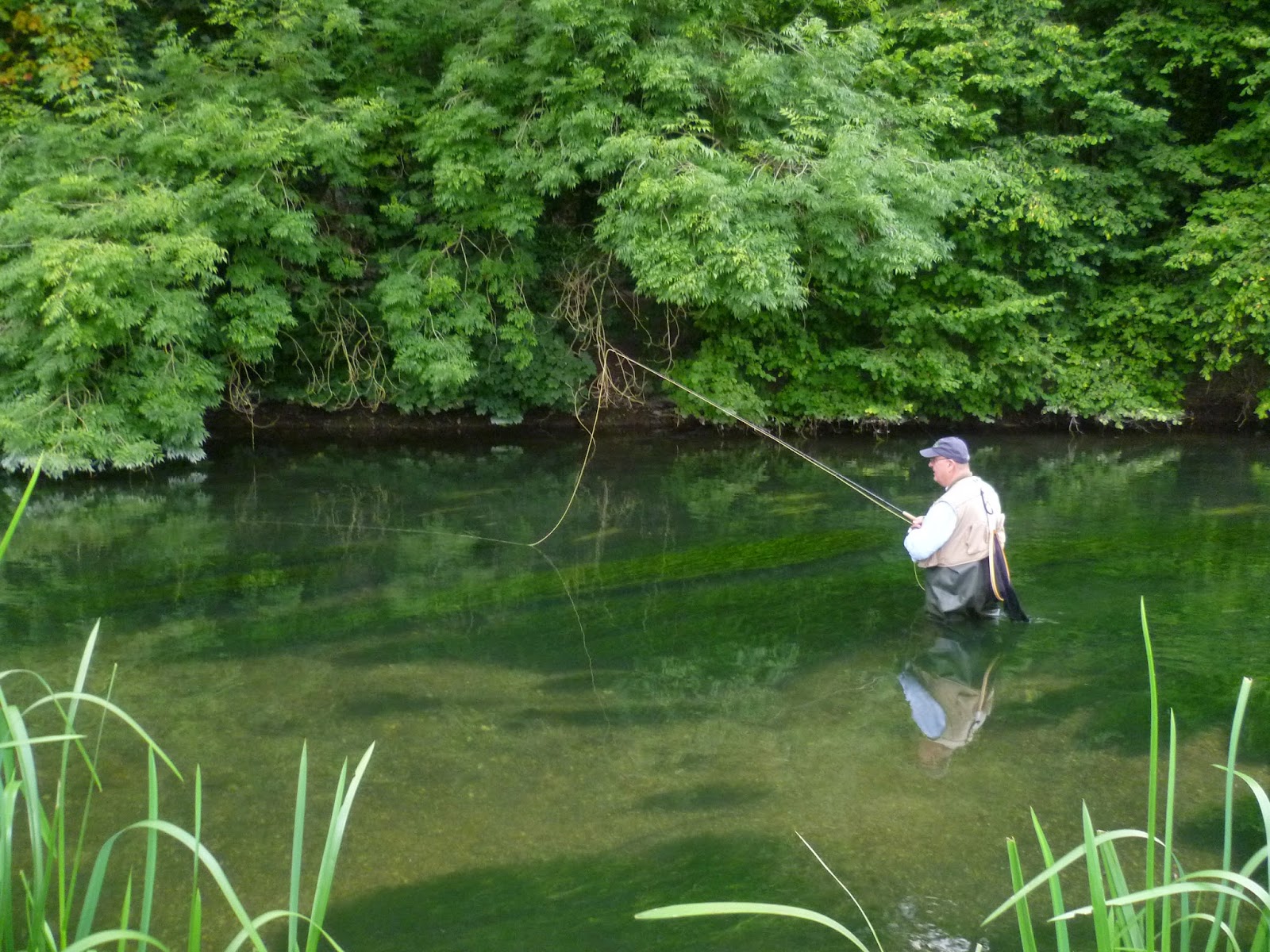
Eventually I managed to cover a fish without any drag and was rewarded with a half pound brownie. So I walked onto the next beat and watched a gentleman laying a nice straight line on the water in classic upstream nymphing style.

We exchanged a few pleasantries and names and he kindly allowed me to take his photograph.  Sadly, I didn't write his name down, I do hope he forgives me and the picture compensates.
 
Now you have been waiting for the action and this is when it starts.  Working my way upstream I soon spotted some serious sub surface activity in the wading section.  Entering the water and using a tiny gold-head nymph I started to get touches.  Refining my technique with a very straight up stream cast and a quick retrieve, so there was no slack between my hand and the fly, I started to pick up good-sized fish, mainly brownies, but one whopping grayling.  Sadly I also caught a large brown that had one side split open by a preditor!  He put up an energetic fight and was obviously feeding so I decided to return him to the river.


After a frantic hour in which I caught five good-sized trout and four grayling, things calmed down and I had a break.  Whilst wading elsewhere I first noticed a heron banging around in a tree on the edge of the river.  At first I ignored it but then roughly under where it had been I noticed a twitching reed with something really bright flashing where the reed entered the water.  This went on for sometime so I decided to investigate.  Well the flashing was caused by a vertical reed moving in the current lifting a horizontal reed lying on the water.  As the reed was lifted the film of water on it was catching the sun and flashing like a natural heliograph.  Having solved the mystery I was just about to move away when I saw a movement in the water between the reeds and the bank. Wow, there were between fifteen and twenty large torpedo shapes quietly swimming there and some of them were honkers!!!  Concious that I was in full view of them I eased myself away downstream putting a bush between them and me.  I then started on developing my strategy.  How could I cover them when I had to fish upstream, dodge overhead branches and avoid the massive weed bed with the reed sticking up out of it between them and me?  After a few minutes deliberation, you cannot rush opportunities like this, I felt I had a plan, albeit a risky one.
 
Having manouvred myself into position I cast a few metres upstream of them and as the line drifted downstream towards the vertical reed I flicked the line gently over it. The next thing was one of the fish broke ranks and presumably chased the nymph as the line went tight and I was in and he was on!  Before the fish realised what was happening I managed to get him to the top and over the weed into open water where he went ballistic.  Eventually I got him under control and brought him to hand where I used the old trick of turning him upside down.  This disorientates the fish and they stop struggling enabling easier unhooking.  The crucial thing is to turn them back the right way up before letting them swim off  your hand.

 
I was pleased to see that the quick exit of their companion had not disturbed the other members of the shoal so I decided to see if I could manage a repeat performance.  Well I spent the next hour and a half trying to cast to these fish to no avail, I just could not get the presentation right, but it was great fun trying and as I close my eyes I can still see them there.  I retreated exhausted, concious that I had a long drive ahead.  It was a priceless experience I will always remember. Thanks for letting me share it.
Incidentally as I was leaving the fishery I was politely stopped by a club bailiff who asked to see my membership book.  This I gladly handed over for him to check and sign.  This friendly policing of the water helps maintain the quality of the fishing.


Friday, 2 August 2013

Bewl Water Fishing Report 1 August 2013

Having been away from Bewl for over 8 weeks (mainly in the USA) and knowing the weather in the UK has been warm I read last weeks fishing report with interest. I reprint it here as I know fishers from across the globe are interested.

Picture courtesy of "fishactive.com"

"Cooler weather over the last week has improved the fishing at Bewl. The fish are not as deep and have spread out across the water. Anglers have been catching at a depth of about 10ft rather than the 25 ft during the last few weeks.

This week's rod average is an excellent 3.58. Brown trout are beginning to show, especially at the end of Hook Straight. A brown of 6lb 8oz was caught and released.

Best areas for boats are the Main Bowl, the cages and the end of Hook Straight. Bank fishing is still challenging and the deeper water off of Chingley is the best place to try.
 
Successful flies have been Buzzers, mini lures, Cat's Whiskers, Minkies, Minkie Boobies and Sparkler Boobies.

An early reminder that no boats are available on Wednesday 18 September when the Annual Grand Max competition will be taking place.
Water temperature 20 degC, water level 85.5%"

So I might be tempted to give it a go!